
How Glendora Residents Are Found
Every Glendora residents directory search works better when ownership, occupancy, registration, and history stay separate. An assessor parcel shows a situs address, an AIN, physical details, and roll values. Yet it never proves a Glendora person actually sleeps there. A deed names the parties to a recorded interest. A city directory lists a household for one year only. A voter-status result authenticates the signer, not a street. Those limits set the order of the search.
Start with your strongest Glendora clue and keep the custodian's exact spelling. An address belongs in the Los Angeles County Assessor Portal. An older Glendora household lives in the free Glendora Community Archive. A court matter fits the Los Angeles Superior Court case search. A Glendora record may not be online. The California Public Records Act route then leads to the agency that holds it.
- Record the Glendora name, address, alternate spellings, and the reason for the search.
- Use the Glendora assessor address or AIN search to identify the parcel and its situs facts.
- Check California My Voter Status only for an authorized personal confirmation, never as a Glendora street browser.
- Move from a lawful Glendora owner name and recording year to the RR/CC deed index in Norwalk.
- For earlier Glendora households, search the archive OCR, then inspect the page image and compare dates.
That sequence keeps a current Glendora parcel clue apart from a historical resident clue. It also leaves a clean handoff when a Glendora office, archive, or court clerk must answer the next question in person.
Where Glendora Keeps Resident Records
Glendora sits inside Los Angeles County, so Glendora resident research crosses three levels. The City Clerk holds municipal documents and starts a CPRA request. The county assessor keeps Glendora parcel records. The Registrar-Recorder/County Clerk keeps Glendora recorded-instrument systems. California runs the statewide voter, vital, corporate, license, prison, and privacy services. Know the keeper first. That habit alone prevents a dead-end search at the wrong counter.
Glendora City Clerk
116 E. Foothill Blvd.
Glendora, CA 91741
(626) 914-8210
Mon-Fri, 8-5
Los Angeles County Assessor
Glendora parcel and map search
Glendora AIN or situs address
Current roll snapshot
Assessor Portal
LA County RR/CC
Glendora real estate records
1851 to present
Norwalk name/year index
RR/CC real estate records
Among Glendora state-held records, vital records, archival services, licensing, and corporate filings each answer a different question. No single office replaces the others.
Current Glendora Resident Directory Sources
These Glendora sources can place a person, parcel, or listed household in context. But their fields do not mean the same thing. The table maps what each custodian actually exposes. A source naming a Glendora owner is not a resident roster. A personal voter result is not permission to copy a block.
| Source | What It Lists | Keeper | Access |
|---|---|---|---|
| Glendora assessor parcel roll | AIN, situs, traits, values | LA County Assessor | Free AIN/address portal |
| Glendora voter status | One person's registration status | California and LA County elections | Authenticated personal lookup |
| Glendora recorded instruments | Deed parties, liens, legal descriptions | LA County RR/CC | Office index and copy request |
| Glendora permits and planning | Address projects and applications | City of Glendora | Civic Access portal |
| Glendora historical directories | Listed names and addresses by year | Glendora Community Archive | Free OCR and page scans |
For one Glendora person, a Glendora resident lookup can combine these sources without treating any single row as proof of present occupancy. For an entire Glendora street, start with the address path in the By Street section. Then keep owner, occupant, and historical listing columns separate.
- Roll
- An official list or assessment record maintained for a defined purpose, such as parcels or registrations.
- Index
- A finding aid that points to a record; it is not always the record image itself.
- Glendora criss-cross directory
- A reverse directory arranged by address so a place can lead to a listed name.
- Glendora parcel
- A county-mapped unit of land identified by an AIN and physical boundaries.
Why Glendora Resident Deeds Are Not Online
Los Angeles County recorded instruments reach back to 1851. Yet the RR/CC offers no public Internet deed index for Glendora. There is also no indexing by street address or AIN. The search key is a person or entity name paired with a recording year. That quirk reshapes the first step. The parcel system supplies a lawful ownership clue and legal description. The recorder index then confirms the document trail at the county facility.
Glendora records from 1851 through 1957 sit on the lower level in Norwalk. Records from 1958 forward are upstairs. A copy request generally needs indexed names, year, title, or document information. The published fee schedule lists a name-and-year search charge plus per-page copy fees. The RR/CC posted a fee notice on April 28, 2026. So confirm the current amount on the county recorded-document request page before sending payment.
A Glendora deed proves a recorded property interest. It does not prove the grantee ever occupied the home. Pair the title trail with a city directory, census entry, permit chronology, or other independent record. Do this before describing any past household.
Note: A Glendora legal description can survive a street-name change, while an old street address may not lead to the same parcel.
The RR/CC recorder services page states the Glendora office-only index rule plainly.
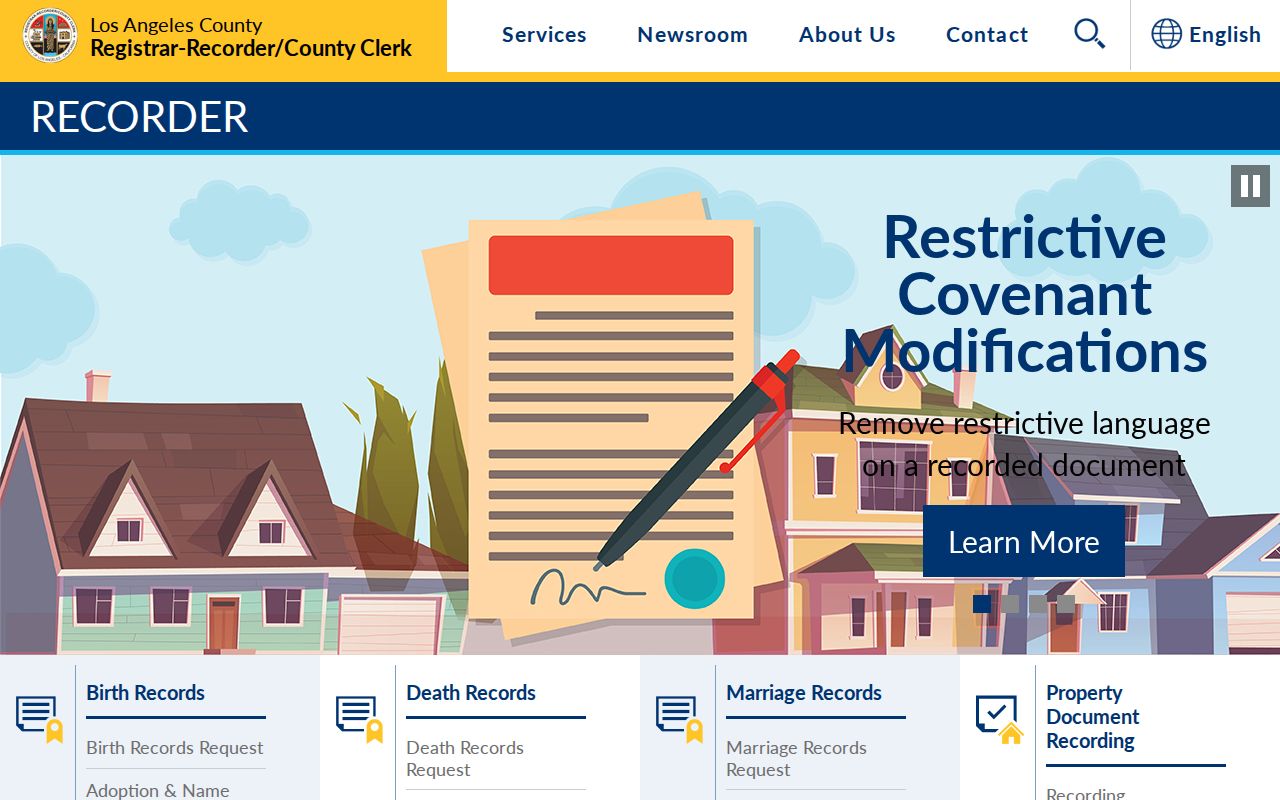
The notice draws the Glendora boundary clearly. An online property search is simply not the same tool as the county's name-and-year deed index.
Glendora Resident AIN and Address Search
Start with the Los Angeles County Assessor Portal. Use it when the clue is a Glendora address. Search by a ten-digit AIN or a situs address. Then open the map view to confirm the parcel shape. The public record displays parcel identity, use type, parcel type, tax-rate area, status, create and delete dates, exemptions, use and design details, units, beds, baths, square footage, year built, land area, map links, and roll values. One thing stays hidden. The public card shows no Glendora owner name or mailing address.
| Search by AIN or Address | Autocomplete or text; required; ten-digit AIN or situs address |
|---|---|
| Basic Search | Optional tab for the general parcel route |
| Legal Search | Optional tab for legal-description research |
| Map Search | Optional tab for mapped parcel discovery |
Three labels matter in a Glendora parcel record. The situs is the physical location of the parcel. The mailing address is where correspondence goes. The legal description fixes the title boundary. An AIN ties the assessor parcel to a map. It hands the recorder search a firmer starting clue. The local mapping hub carries the Glendora layer. It offers no wildcard street browse, and it offers no current owner-name search.
Glendora Resident Voter Status Is Personal
California My Voter Status and the LA County voter-status tool serve one purpose. That purpose is an authorized Glendora personal confirmation. The fields are last name, birthdate, house number, and ZIP Code. A person can confirm an own registration status this way. Nobody can browse all registered voters on a Glendora street. A separate voter-file request is different. It may yield name, date of birth, registration date, residential and mailing address, precinct, party preference, optional participation history, and districts, subject to a contract, a lawful purpose, and a fee.
California Elections Code section 2194 keeps certain data out of any release. Driver-license and identification numbers, Social Security digits, unique identifiers, and signatures stay protected. Ballot choices never appear. The state schedule lists countywide files at $146. Precinct, district, or city files run $54, and an added file costs $39. Confirm those amounts before relying on them. Candidates, committees, and public political-purpose requests follow different rules for a Glendora street index.
Use the California My Voter Status route for your own Glendora check. The LA County status tool works when that office is the custodian. A voter row is residency evidence at a point in time. It is not a public Glendora residents directory.
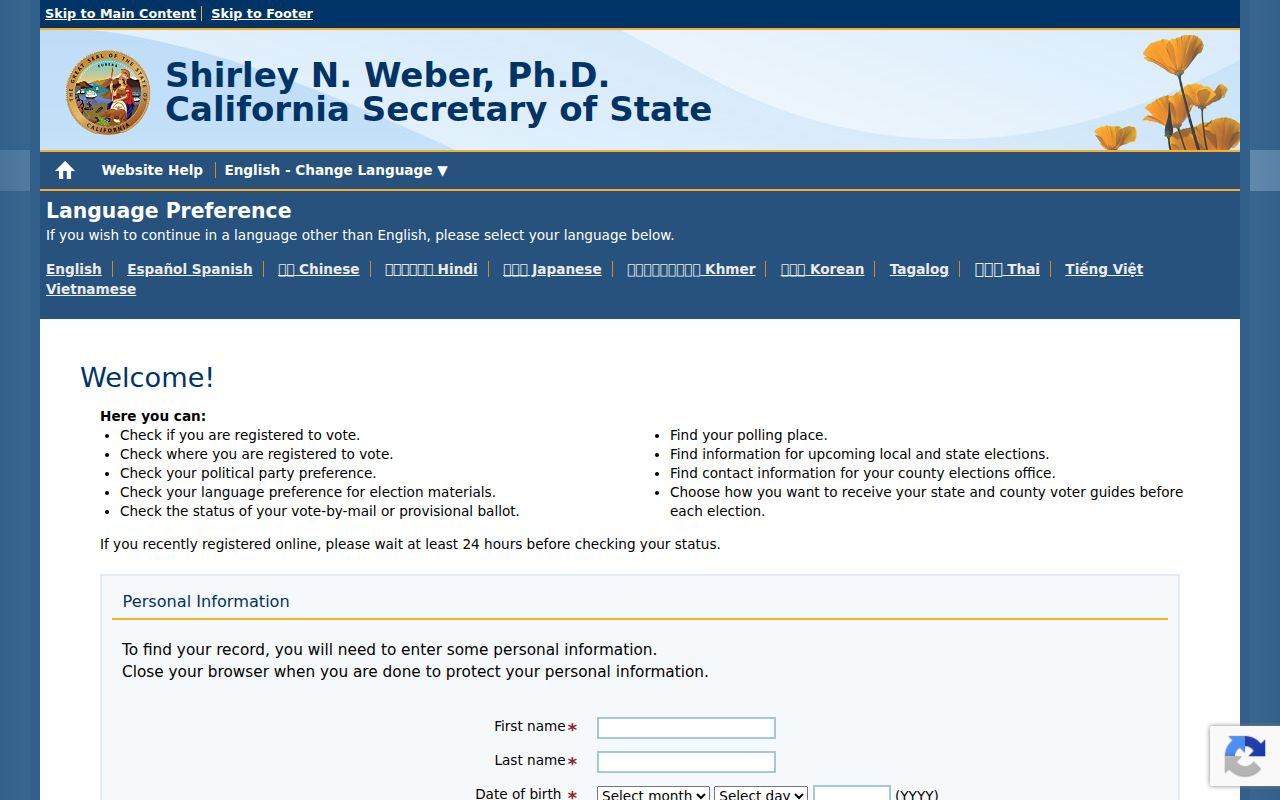
The state lookup page asks for four matching fields. That design makes it a Glendora personal verification step, not an open name list.
Glendora Resident Court Name Search Routes
Glendora matters route to the Superior Court of California, County of Los Angeles. The Glendora court page offers an "Enter case number" path and an "Access Case" action. It also offers an "Access Calendar" path for future hearings. Civil, family, probate, and some small-claims name searches run through a paid party-search route. Criminal matters carry a defendant-name route. Selected civil and small-claims document images may be available through an account or guest access. Criminal and family images stay offline through that channel.
A Glendora result may show the case number, parties, and case type. It may also show the filing or register of actions and the hearing calendar. Name and document searches incur public-access fees. Those fees fall under California Rule of Court 2.506 and Government Code section 68150(l). Courthouse terminals and the Glendora clerk remain the fallback. The online route does not always answer the question. Juvenile, adoption, mental-health, sealed, and other protected files remain restricted.
Federal matters for Glendora go to the Central District of California, Western Division. Access runs through a federal docket account. Party and case searches normally cost $0.10 per page. A document is normally capped at $3. Quarterly fees of $30 or less are waived. The LA Court Find a Case page is the local starting point.
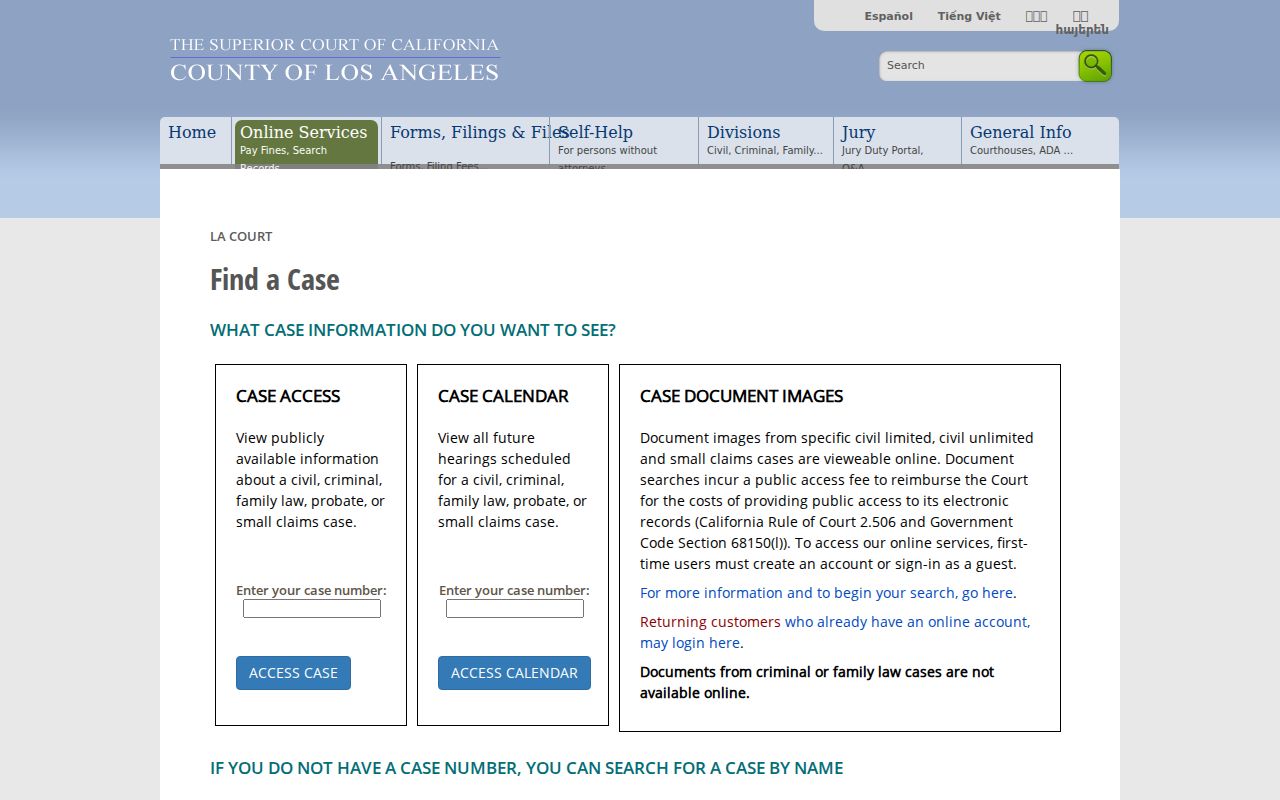
Treat the Glendora court result as a case chronology. That framing keeps parties, hearings, and protected files in context, not a resident roster.
Glendora Resident Vital Copy Choices
Glendora birth records in Los Angeles County begin in 1866. California vital records follow no simple "open after a set number of years" rule. An informational copy can document an event without proving identity. An authorized copy requires the status set by law. It also requires a sworn identity statement, notarized for mail or online requests. The county uses VitalChek for online orders. The county office and state vital-records office provide the forms and custody information.
The Glendora county birth fee is $34. Birth records from 1962 forward, except 1972 through 1977, can be supplied at appointment. Older ranges, the exception years, and informational copies are mailed within 20 working days. CDPH fees listed for 2026 were $31 for birth. They were $26 for death, $19 for marriage, and $18 for a dissolution certificate. A failed search keeps its fee. It produces a no-public-record certificate.
Public marriage and confidential marriage differ. Family Code section 511 limits a confidential marriage certificate to spouses or a court order. Adoption files are confidential. A divorce judgment comes from the Superior Court. CDPH supplies a certificate of record. Those distinctions matter. They matter when a Glendora resident lookup needs a life-event clue rather than a present address.
Note: Choose Glendora informational or authorized copies based on the question, because the two products carry different identity and eligibility effects.
Glendora Resident History on the Shelf
The Community Archive makes the historical Glendora residents directory shelf unusually easy to work with. It offers free OCR scans of every volume. The directory run alone holds 20,524 pages. Glendora City Directories span 1957 through 1994. A December 1946 telephone directory sits alongside them. Nearby newspaper and magazine runs add neighborhood context: Glendora Gleaner, 1901-1932; Press and Gleaner, 1932-1948; Glendora Press, 1926-1962; Community News, 1994-2018; and Glendoran Magazine, 1983-2022.
Start with a surname and street. Search the Glendora archive, then open the page image itself. OCR stumbles on narrow columns, initials, diacritics, abbreviations, and compound Spanish surnames. A typical city directory entry lists the name and address. A spouse may appear in parentheses. You may also find an occupation and sometimes an owner or non-owner mark, when the volume uses one. Remember the limit. A directory is a time-specific listing. It is not proof that every member of a Glendora household actually lived there.
The Glendora city directories page covers the collection-reading method in depth. The Glendora local-history service explains the archive itself. The Historical Society adds photographs, yearbooks, maps, citrus and water ledgers, and named family material.
Glendora Resident Business and License Cross-Checks
A Glendora business or professional record can corroborate a name without proving a home address. Glendora requires a city business license. It routes searches to HdL at the city business-license portal. The portal covers licensed-business search, applications, renewal, payment, and closure. The Business Support Center number is (626) 376-4678, and the listed email is Glendora@hdlgov.com.
For a Glendora company, California Secretary of State bizfile is the starting point. It shows entity status, dates, addresses, agent information, and filings. LA County RR/CC handles fictitious business names. Professional credentials go through the relevant board. Options include DCA, CSLB, the Medical Board, RN Board, State Bar, DRE, teacher credential, ABC, or LA County health inspection lookup.
A city license answers a Glendora tax or operating-registration question. A professional license answers a credential question. An agent address answers a filing question. Treat each as an affiliation clue and verify the underlying record with its custodian.
Glendora Resident CPRA Requests
Glendora's Public Records Act anchor is Government Code section 7920.000 and following. A request goes to the agency holding the record. City Clerk Kathleen Sessman is the local records officer. Her City Clerk page is the starting point for Glendora municipal legislation, permits, licenses, police records, agreements, campaign filings, minutes, ordinances, resolutions, older packets, and the Municipal Code.
Timing follows a set pattern. A Glendora agency ordinarily decides within ten calendar days whether it holds responsive disclosable records. Unusual circumstances can add up to fourteen days. Inspection is generally free. Copies usually cost direct duplication price unless another law controls. Electronic extraction or programming can carry a separate charge. Ask narrowly. Request a specific record type, date span, department, address, or file number, not "everyone in Glendora."
The Glendora documents hub may already hold the agreement, agenda packet, ordinance, or resolution you need, so reserve a CPRA request for an identifiable Glendora item that is not posted. County and state offices run their own channels for deeds, vital records, court files, voter data, and licenses.
Protected Glendora Resident Addresses
Some people never appear in a Glendora residents directory. California gives them a substitute-address route. Safe at Home supplies qualifying Glendora participants with a substitute address and mail forwarding. Government Code section 6208.1 shields a participant's address and phone after a demand. Recorder redaction rules, Government Code sections 27300 through 27307, address Social Security information in recorded documents.
State privacy rights add more tools. Californians hold rights of access, deletion, correction, opt-out of sale or sharing, limits on sensitive information, and nondiscrimination. Global Privacy Control is recognized. In 2026, California DROP opened a free request that can reach more than 500 registered data brokers. Broker processing begins August 1, 2026. Deleting a broker copy leaves the government source intact. The official California deletion platform is the proper starting point, and the California Safe at Home program page is the state source for qualifying Glendora substitute-address protection.
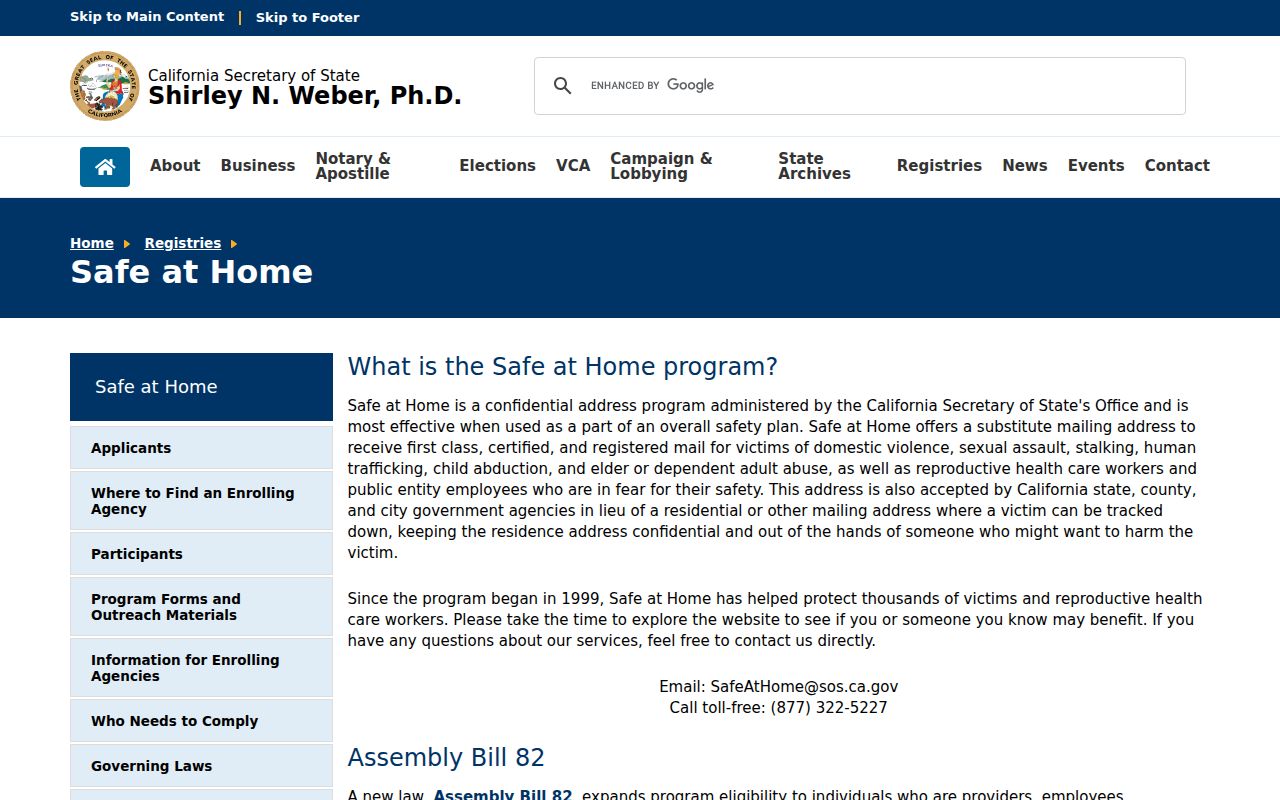
A missing Glendora address proves nothing. It is not evidence that a person has no record or no connection to Glendora. The California DROP platform handles separate data-broker deletion.
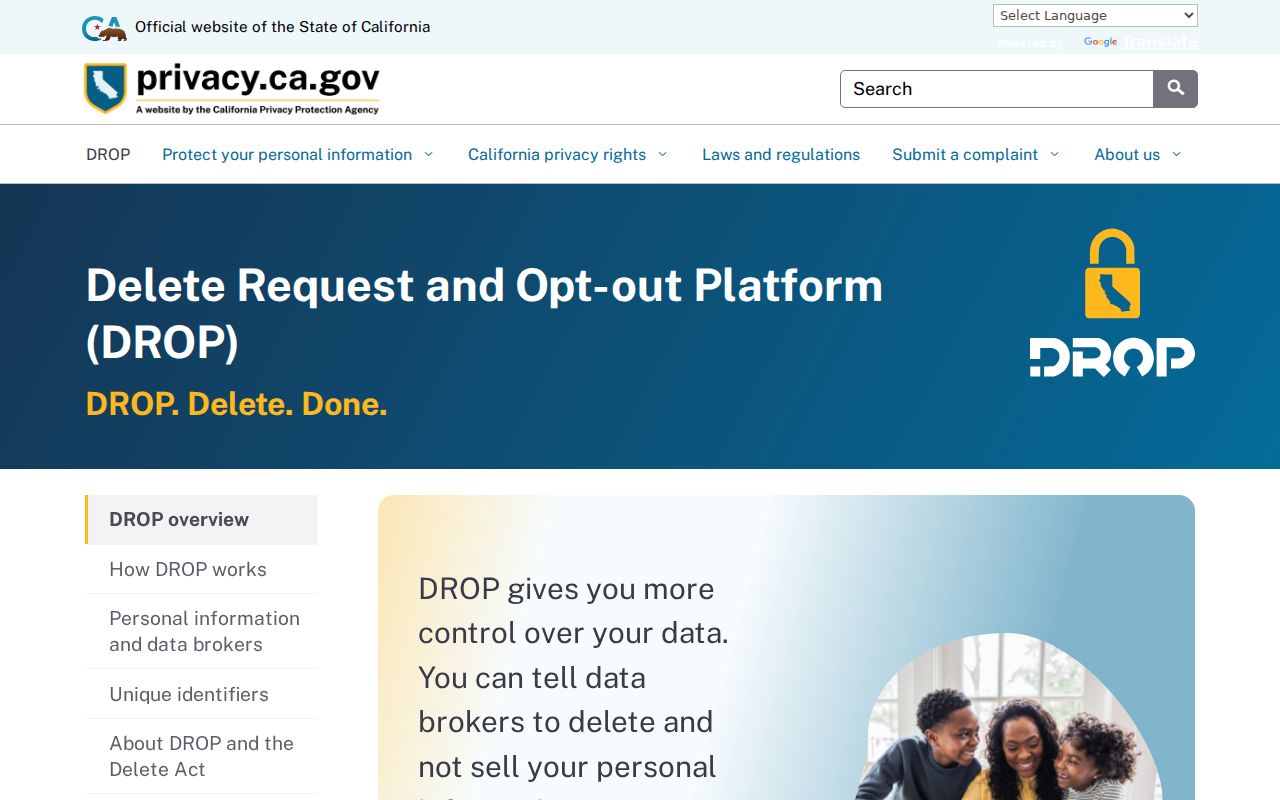
Glendora data-broker deletion can shrink the copied trail. The county, city, or state custodian remains the right place to ask for a correction to the original record.
What Glendora Resident Records Cannot Prove
Official Glendora records are strong when their field matches the question. Outside that field, they run thin. A parcel can locate land. A deed can show a recorded interest. A permit can date a project. A directory shows a listed household. None of these facts alone proves who is present today.
| Source | Useful role | Boundary |
|---|---|---|
| Glendora assessor AIN and situs | Find a parcel and physical facts | Current occupant |
| Glendora recorded deed | Follow a named property interest | Continuous residence |
| Glendora city permit | Date work at an address | Applicant lived there |
| Directory or census | Place a listed household in time | Complete household membership |
| Voter status | Confirm your own registration | Public street browsing |
| Commercial compilation | Possible lead across sources | No custodian or guaranteed correction route |
Lawful use. Glendora records support personal, lawful Glendora research and civic understanding. Do not use a name or address to stalk, harass, intimidate, or harm anyone.
Commercial compilers repackage Glendora official sources. They can charge for access, lag behind the custodian, and lack authority. When a record is wrong, stale, or incomplete, contact the office that created or holds it and ask about its correction process.
Glendora Resident Records Through Time
Glendora dates to 1887 and incorporated as a city in 1911. Los Angeles County formed in 1850. Its deed series opens the next year, 1851, and it still anchors most property research in the region. From there, the local record trail picks up speed. A reading room opened in 1904. The city began supporting a library in 1912. The present library building arrived in 1972, and a computerized catalog replaced the card drawers in 1989.
One episode from 1918 shows why the Glendora library earned its place in any lookup. During the influenza epidemic that year, books coming back from sick homes were sealed away for a full year before anyone could touch them again. Care like that shaped a collection people still trust. Digitized agendas, Civic Access, and the Community Archive now put many records within easy reach. Still, no database turns every old Glendora name into a neat public list. The strongest residents directory work pairs a modern parcel clue with a dated city directory, a court result, a deed, or an archive page.
Two trails cover most needs. For a Glendora street, start with By Street. For a former Glendora household, try Past Residents. Both work because the record type, the time period, and the access rule stay visible at every step.